
Jun
PhD Defense by Johan Lindberg: Robust & Optimal Control of Mass-Spring Networks — with Power System Applications
All seminars are held at the Department of Automatic Control, in the seminar room M 3170-73 on the third floor in the M-building, unless stated otherwise.
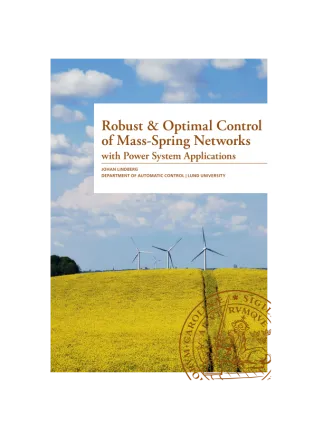
- Title: Robust & Optimal Control of Mass-Spring Networks — with Power System Applications
- Speaker: Johan Lindberg
- Opponent: Professor Marija D. Ilić, Massachusetts Institute of Technology
- Committee:
- Associate Professor Andre Teixeira, Uppsala universitet
- Dr Frank Hellman, Potsdam lnstitute for Climate Impact Research
- Universitetslektor Ross Drummond, University of Sheffield
- Supervisor: Richard Pates, Automatic Control Lund University
- Assistant supervisor: Anders Rantzer, Automatic Control Lund University
- Where: Lecture hall M:A, LTH building M, Ole Römers väg 1
- Zoom: Link to zoom meeting
- When: June 5th, 09:15
Abstract
Electric power systems are undergoing significant transformations as more sectors of society are electrified and increasing amounts of solar and wind power generation are added to the grid. The growing share of renewable generation is expected to influence the dynamic behaviour of power systems, creating a need for new control strategies. This thesis investigates robust and optimal control with a focus on performance, robustness, and disturbance attenuation. The systems under consideration are damped mass-spring systems that capture key aspects of AC frequency dynamics in power systems.
The type of control investigated is the so-called H2 and H-infinity optimal control. These are two frameworks for deriving optimal controllers with respect to different objectives. The H2 optimal control framework seeks to minimise the energy throughput from external stochastic disturbances to the system's performance output, while H-infinity optimal control instead seeks to minimise the effect of the worst-case disturbance.
Papers I to III in this thesis focus on deriving analytical results for the smallest achievable disturbance gains in the two norms and provide controllers that attain these bounds. Papers III and IV investigate a robustness margin that is closely related to H-infinity control. The main contributions are the analytical nature of the controllers, disturbance gain expressions, and the robustness margins. These results stand in contrast to conventional approaches to H2 and H-infinity optimal control, which typically rely on numerical methods and require recomputation of controllers for each new problem configuration.
All expressions provided in this thesis are highly transparent, clearly illustrating which system properties most strongly influence robustness and disturbance attenuation. The expressions deliver direct guidance for controller design. In all papers, the theoretical results are applied to power system models that closely resemble damped mass-spring networks, demonstrating the strong applicability of the theory to power system control, particularly for AC frequency control.
About the event
Location:
Lecture hall M:A, LTH building M, Ole Römers väg 1
Contact:
richard [dot] pates [at] control [dot] lth [dot] se